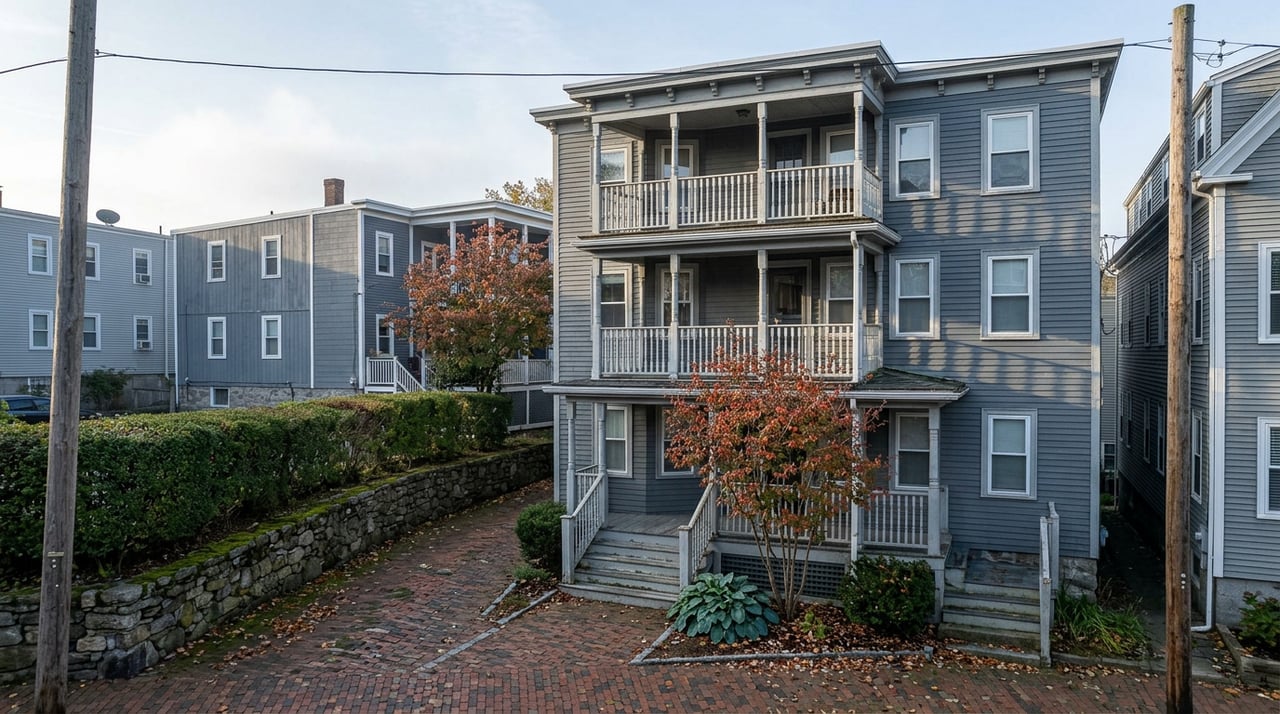
An investor closes on a triple-decker near Nubian Square, guts it over a winter, and splits the building into three individually deeded condo units. No tenant notice form. No relocation check. No year-long clock ticking before the sale can close. That path exists today because the City of Boston's Condominium and Cooperative Conversion Ordinance only applies to buildings with four or more rental units built before December 1983. A triple-decker has three units. It has never had to follow that rule.
Universal Hub reported that on September 17, 2026, two Boston city councilors asked the city to close that gap, naming Roxbury as one of the places where it matters most. If you are underwriting a multi-family deal in Roxbury right now, that proposal changes what your exit actually looks like, even though no vote has happened yet.
The Four-Unit Line
Boston's Condominium and Cooperative Conversion Ordinance, last updated in March 2021, kicks in only for properties built before December 1983 with four or more rental units where the owner intends to convert to condos or a cooperative. Once a building crosses that line, the owner has to file a Conversion Plan with the Mayor's Office of Housing, pay a $1,000 permit fee per unit, and give tenants a formal Tenant Notification Form. Tenants get a one-year lease extension before they can be displaced, five years if they qualify as elderly, disabled, or low-to-moderate income. They get first right to buy their own unit. If they don't buy, the owner owes them $10,000 in relocation money, or $15,000 for the protected categories.
None of that applies to a two-family or three-family building. The ordinance was written around the four-unit threshold and has stayed there for over two decades.
Universal Hub quoted City Councilor Liz Breadon, who represents Allston and Brighton, on the stakes of the proposal she and Councilor Gabriela Coletta Zapata brought to the full council this month:
"This is critical in a city where triple deckers make up a large share of a naturally affordable housing."
Breadon pointed specifically to triple-deckers in Dorchester, Mattapan, Roxbury, Hyde Park, West Roxbury, and Roslindale. Coletta Zapata added East Boston to the list. The state legislature gave Boston the authority to make this change back in 2024. The council is only now deciding what to do with it.
Where Almost All the Real Conversions Are Actually Happening
The city's own numbers explain why this matters more in Roxbury than the four-unit rule would suggest. A year earlier, in September 2025, the Government Operations Committee held a hearing on an earlier version of this idea, one that would have covered any building with two or more units while keeping an exemption for owner-occupied small buildings. No vote came out of that hearing. But the modeling presented that day is the number worth sitting with.
The city's Mayor's Office of Housing found that expanding the ordinance down to two-unit buildings would have covered 97 to 99 percent of the rental units actually lost to conversion in recent years. The current four-unit threshold, the one still in effect today, covers roughly 25 percent. Between 2019 and 2024, the city lost about 2,100 rental units to condo conversion. Under the rule as written, the vast majority of those conversions happened in buildings small enough to skip every protection the ordinance was designed to provide.
That is the part that should reframe how you read a Roxbury cap rate. The ordinance was built to regulate conversions, and conversions have been concentrating almost entirely in the size of building it does not touch.
What This Actually Does to the Numbers on a Roxbury Deal
Roxbury has been one of the stronger cap rate stories in Boston this year precisely because triple-deckers there trade at a discount to the rest of the city while renting well. Opportunistic multi-family deals in Roxbury have been running in the mid-5s to upper-6 percent cap rate range through 2026, and post-rehab triple-deckers priced between roughly $450,000 and $850,000 have been generating combined rents in the $5,000 to $7,500 monthly range once stabilized, producing some of the strongest debt-coverage ratios in the city. A renovated four-unit near Nubian Square listed this year advertising a 6.7 percent in-place cap rate, and a similar renovated multi-family closer to Fort Hill listed with a 7.4 percent number. Roxbury's own median sale price sat at $675,000 over the three months ending in May 2026, down from the prior year, with the average home value around $640,000.
None of that math includes a relocation check or a mandatory notice year, because none of it has had to. The moment a triple-decker crosses into the same ordinance that governs larger buildings, an investor planning to convert and resell individual units has to build in the cost of a delayed closing, a per-unit relocation payment if tenants decline to buy, and the administrative time of an Inspectional Services Department review before the conversion can proceed. On a $650,000 acquisition with two rental units occupied, that is not a rounding error. It is a line item that has not existed in anyone's underwriting model for as long as Boston's triple-deckers have been exempt.
Here is the practical difference between the rule as written today and the rule as proposed this month:
| Today, buildings with 4+ units, pre-1983 | Proposed for triple-deckers and two-families | |
|---|---|---|
| Minimum tenant notice | 1 year | At least 1 year |
| Notice for elderly, disabled, or low-to-moderate income tenants | 5 years | 2 years |
| Tenant right to purchase unit | Yes | Yes |
| Relocation payment if tenant doesn't buy | $10,000 to $15,000 per unit | $10,000 to $15,000 per unit |
| Permit review required | Yes, Mayor's Office of Housing and ISD | Yes, ISD |
| Applies to triple-deckers today | No | Not yet, pending council action |
The notice period the council is discussing for small buildings runs shorter for protected tenants than the existing rule for larger buildings, two years instead of five, but the relocation payment and the purchase right land in the same range either way.
Where the Docket Stands Right Now
This is the second time in a year the city has taken this up. The September 2025 hearing on the broader two-unit-and-above version ended without a vote, with committee staff citing the need for more work on enforcement mechanics and questions about how far the city's authority extends under state law. This month's proposal is narrower, targeting triple-deckers and two-families specifically rather than the full two-plus-unit range, and it has been referred to the Government Operations Committee, chaired by Coletta Zapata, for public hearings and working sessions before any ordinance language goes back to the full council and the mayor.
That means nothing has changed yet for a deal closing this fall. It also means an investor modeling a five-year hold on a Roxbury triple-decker is modeling against a rule that a second council effort in twelve months is actively trying to change. The smart move is not to assume the exemption disappears on a specific date. It is to stop treating it as permanent in your spreadsheet.
A Few Questions Worth Answering Directly
Does this affect a triple-decker where the owner lives in one unit? The September 2025 version of this proposal discussed keeping an exemption for owner-occupied buildings under four units. The September 2026 proposal as reported does not yet specify that carve-out, which is exactly the kind of detail the upcoming committee hearings are meant to settle.
If I'm under contract on a Roxbury multi-family right now, does anything change at closing? No. The current four-unit, pre-1983 threshold is still the operative rule until the council passes new language and the mayor signs it. Nothing in the September 2026 proposal is in effect yet.
What should someone evaluating a triple-decker purchase in Roxbury actually do with this? Run the numbers both ways. Price the deal assuming the exemption holds, then price it again assuming a one-year notice period and a $10,000 to $15,000 per-unit relocation cost on exit. If the deal only works under the first scenario, that is worth knowing before you sign anything, not after.
Roxbury's triple-decker math has been good this year for real reasons: strong rents, a discount to Dorchester and Jamaica Plain pricing, and proximity to the Longwood Medical Area and the Silver Line. None of that changes. What changes is how much of that return has been resting on a regulatory gap that two councilors just asked the city to look at closing, for the second time in a year, with Roxbury named directly in the record.
If you're weighing a multi-family purchase in Roxbury and want someone who tracks this kind of local detail before you write an offer, not after, Pondside Realty works these deals from the storefront on Centre Street. Reach out for a walkthrough of what a specific Roxbury property actually pencils out to under both versions of this rule.
This article is general information, not legal, tax or financial advice. Consult a qualified professional about your situation.